Home/Chiropractic/Chiropractic
Chiropractic revenue managementWhich Software Are You Billing Out Of?
It is the first question worth answering, because it decides which clearinghouse your claims move through, what gets checked before they go out, and what your billing partner can actually see. You are not being asked to change any of it. The point of this page is the opposite: whichever system your practice runs, it stays, and CareVixis manages the revenue cycle around it.
Start with the free CareVixis practice assessment. No email required.

You Already Chose Your Software.
Your team knows it. The schedule runs on it, the notes live in it, the charges come out of it.
Nothing on this page asks you to change that.
The Claim Leaves It Anyway.
From there it is a clearinghouse, a payer, a remittance file and, sometimes, a decision you did not expect.
Most of that chain sits outside whatever you bought.
Each Link Works. The Gaps Are the Problem.
A denial gets reworked but never explained. A payment lands below the contracted rate and nobody notices, because it was paid.
A liability balance sits for months looking exactly like a claim that was lost.
In Chiropractic, the Argument Is Often Whether, Not How Much.
Coverage can turn on whether care is active treatment or maintenance, which is a clinical judgement rather than a field anything can validate.
That makes the denials harder to prevent and much more worth understanding.
Keep What You Run. Hand Over the Rest.
CareVixis manages the revenue cycle around your existing workflow and tells you where things stand.
Start by looking at your own numbers rather than taking anyone's word for it.
Your software runs the practice. CareVixis runs the revenue cycle around it.
The detail, if you want it
What actually differs between chiropractic systems, what makes chiropractic revenue unusual, where CareVixis publishes system-specific detail, and the questions worth asking any billing company.
Do I have to change my chiropractic EHR to outsource billing?
No. A chiropractic practice does not need to replace its EHR or practice management software to work with CareVixis. The clinical and front-desk workflow stays exactly where the team already knows it: scheduling, charting, the SOAP note, the charge.
CareVixis is a revenue management company rather than a software vendor, so what changes is who is accountable for the money after the claim leaves your system. CareVixis claims no API integration, native integration, certification, partnership or endorsement with any chiropractic software vendor, and the pages below quote each vendor's own published descriptions rather than asserting anything on their behalf.
What Actually Changes Between Chiropractic Systems
['Not much of the clinical experience, and quite a lot of the revenue cycle. These are the differences that decide what a billing conversation is even about, and they are the reason this hub has a page per system rather than one page with the names swapped.', 'None of this is a ranking, and CareVixis does not publish one. A system is a good fit for a practice or it is not, and that judgement belongs to the practice.']
| What varies | Why it changes the revenue conversation |
|---|---|
| Which clearinghouse | The clearinghouse decides what a rejection looks like and how it is reported back. A rejection never reached adjudication, so there is nothing to appeal; knowing which side a failure happened on is the first branch in any investigation. |
| Whether billing is a tier or a module | Several vendors sell the claims layer separately or only on a higher plan. Two practices can both run the same software and have entirely different claim paths. |
| What is checked before submission | Scrubbing catches what a rule can state in advance. It raises the floor and it changes which denials are left, which is exactly the set worth investigating. |
| How remittance comes back | Automatic download and posting of electronic remittance is common. What differs is how much of the payer's reasoning survives into something a human can act on. |
| Whether the vendor also sells billing services | Some do. Where that is the case, the page for that system says so, quotes it and does not disparage it, and puts the same questions to CareVixis and to them. |
| What the reporting answers | Most systems report what happened. Fewer answer why it keeps happening, which is a different question and usually a different tool. |
CareVixis has not independently tested any vendor's features. Every vendor statement on the pages below is quoted from that vendor's own published material and cited with the date it was read.
Your Software Is Probably Not the Problem
A chiropractic practice can run capable software, document carefully, submit clean claims and still carry aged accounts receivable, unresolved denials, underpayments nobody caught and balances that quietly passed a filing deadline. None of that means the software failed. It means the work that happens after submission is a different job from the work that happens before it.
The revenue cycle is not one system. It is a chain of handoffs between systems and organisations, and most of the links sit outside whatever the practice bought: a clearinghouse, several payers, remittance files, enrollment records, contracts and an appeal process. Each link works. The gaps between them are where money waits.
CareVixis is the accountable layer across that chain. Where it is, what happened, what we did, who owns it, what happens next.
What your EHR is for
- Scheduling and the front desk.
- Charting and the SOAP note.
- Building the charge from the documentation.
- Submitting the claim.
- Posting what comes back.
What CareVixis is for
- Working denials, appeals and rejections.
- Accounts receivable and payer follow-up.
- Root cause behind a repeating failure.
- Payer enrollment and credentialing.
- Telling you where things stand.
What Makes Chiropractic Different
Chiropractic is unusual among specialties in that the argument with payers is often about whether care is covered at all, rather than how much it pays. CareVixis sets out the published rules, in the sources' own terms, on its chiropractic revenue management page. In short:
Coverage turns on a judgement
The line between active treatment and maintenance therapy is a clinical determination that the claim has to declare. It is not something software can check, because it is not a fact about the claim.
The level has to be supported
98940, 98941 and 98942 describe manipulation of different numbers of spinal regions, with 98943 for extraspinal. A downcode is a documentation conversation rather than a claim correction.
Liability cases behave differently
Auto, personal injury and workers' compensation make up an unusually large share of chiropractic receivables, and they age on completely different timelines from commercial claims.
Plans cap what they cover
Visit limits and authorisation thresholds mean a correct, clean, well-documented claim can still fall outside what the plan agreed to pay for.
CareVixis publishes no denial rate, recovery rate or resolution time for chiropractic, and does not suggest every practice experiences any of this. What is happening in a particular practice is a question for that practice's own data.
Where This Fits Around What You Already Run
Where CareVixis publishes chiropractic detail today. A system gets its own page when there is enough verified, cited material to say something specific about the revenue cycle around it, and not before.
- ChiroTouchIts billing layer submits through the Change Healthcare clearinghouse and reconciles payments automatically, and is offered on one tier only. Chiropractic billing and RCM for ChiroTouch practices.
- ChiroFusionBuilt for chiropractors only, it includes electronic claims at no per-claim charge and runs monthly wellness plans, so a practice often has two revenue streams. Chiropractic billing and RCM for ChiroFusion practices.
- JaneIts billing runs through Claim.MD from eligibility to patient balances, and it is chosen disproportionately by clinics running several disciplines at once. Chiropractic billing and RCM for Jane clinics.
- ClinicMind (formerly Genesis)Genesis Chiropractic Software is now ClinicMind, and the platform sells billing and credentialing as well as the EHR. The comparison, put fairly.
- Platinum SystemIt sells growth as part of the operating system rather than as an add-on, which makes the gap between visits delivered and revenue collected the thing to watch. Chiropractic billing and RCM for Platinum System clinics.
- zHealthBuilt around recall, retention and memberships, so visit frequency is high and the maintenance boundary matters more. Chiropractic billing and RCM for zHealth practices.
- ChiroSpringIt describes covering the patient journey through to final reimbursement, which makes the claims that never arrive there the interesting ones. Chiropractic billing and RCM for ChiroSpring practices.
- ECLIPSEOne of the few still offered as software on your own Windows network as well as in a browser, and built around case management. Chiropractic billing and RCM for ECLIPSE practices.
- ChiroHDFamily check-in and bulk scheduling are first-class features, which is where shared policies and individual benefits diverge. Chiropractic billing and RCM for ChiroHD practices.
- The chiropractic rules themselvesThe active treatment and maintenance distinction, the coding families and what the published guidance actually says. Medical billing for chiropractic practices.
- Seeing it in your own data firstFree, view-only analysis of the remittance data your practice already receives, whichever chiropractic system you bill out of, with the denials and the reasons the payer gave. VixisTrace™ for chiropractic billing.
- Your clearinghouseCareVixis documents the major clearinghouses separately, including the one several chiropractic systems submit through. Clearinghouses and remittance data.
- Everything elseMore chiropractic systems are being researched and will appear here as pages, one at a time. CareVixis does not publish a page for a vendor simply because the vendor exists, and will not describe a product it cannot read from a source it trusts.
How to Choose a Chiropractic Billing Company
Nine questions any billing company can be asked, CareVixis included. This page does not claim CareVixis is the best chiropractic billing company; it gives you the questions and answers them.
-
Do I have to change my software to work with you?
With CareVixis, no. If the answer is yes, ask what specifically requires it, because a migration is a large cost to absorb at the start of a billing relationship.
-
What do you do with denials your scrubber did not prevent?
Reworking them is the minimum anyone offers. Ask what happens the second and third time the same denial arrives from the same payer.
-
Who decides whether care is active treatment?
The clinician decides and the documentation supports it. A billing company offering to make that determination is offering the wrong thing.
-
How would an underpayment be noticed?
It was paid, so it appears on no denial report. Ask for the mechanism that catches a claim paid below the contracted rate.
-
How do you handle personal injury and auto balances?
Ask specifically. A general accounts receivable process tends to leave these alone until they are no longer collectable.
-
Who owns the filing deadline?
A claim reworked twice can age past its limit while it looks like it is being handled. Ask how you would know before that happened.
-
Do you also handle credentialing and enrollment?
Enrollment effective dates cause denials that look like coding problems. There is real value in one partner seeing both.
-
What will you show me, and how often?
Ask what the reporting says in a bad month. A partner who only reports good months is not reporting.
-
Is your team in the United States?
Ask where the people working your claims sit, and whether you can speak to them. CareVixis is 100% US based with no outsourcing.
Using Chiropractic? Keep It.
Whatever your practice runs, it stays. The team keeps the scheduling and charting it already knows, the front desk workflow does not change, and nothing clinical moves.
Keeping your system is a supported outcome, not a fallback. If a practice later decides it wants to move to the CareVixis platform, that move may be offered at no additional migration charge, and everything the patient sees still carries the practice's own name and branding.
Keep your software. Hand over the revenue cycle around it.
Questions Chiropractors Ask
Can I keep my chiropractic EHR and outsource my billing?
Yes. Nothing about outsourcing the revenue cycle requires a chiropractic practice to change software. CareVixis works alongside the existing workflow and manages billing, denials, accounts receivable, payer follow-up and credentialing around it.
Does CareVixis replace my chiropractic software?
Not unless you want it to. CareVixis publishes its own practice platform, VixisCare™, and a practice may move to it later. Keeping your current system is a fully supported arrangement, not a lesser one.
Which chiropractic systems does CareVixis work with?
CareVixis works from the claim and remittance data a practice is able to make available, whichever system produced it. Where CareVixis has researched a specific system in enough depth to say something verifiable about the revenue cycle around it, that system has its own page linked above.
Does CareVixis claim a partnership with any chiropractic EHR?
No. CareVixis claims no API integration, native integration, certification, partnership or endorsement with any EHR vendor. Vendor names are used descriptively to identify software a practice may already run, and vendor statements are quoted from that vendor's own published material.
What is VixisIQ™?
VixisIQ™ is the CareVixis revenue intelligence technology. It analyses revenue cycle and remittance data to surface payment patterns, adjustments, denial and rejection patterns, payer behaviour and accounts receivable trends. What it can analyse for a particular practice depends on the data that practice is able to make available.
What is VixisTrace™?
VixisTrace™ is the CareVixis claim root cause analysis technology, covering rejected, denied, underpaid and otherwise problematic claims. The objective is continuous improvement: identify preventable patterns, address their causes, and reduce unnecessary repeat failures.
Can CareVixis work old chiropractic accounts receivable?
Yes. Legacy accounts receivable is a separate arrangement and is charged on what CareVixis actually recovers rather than on the balance handed over. Terms are on the pricing page.
Does CareVixis handle chiropractic credentialing?
Yes, through VixisCred™. Payer enrollment matters here because effective dates produce denials that read as coding problems. Terms are on the pricing page.
Keep Chiropractic. Add Revenue Intelligence.
You do not have to change the software your team knows to get control of what happens to your money after the claim leaves it.
Free. No obligation. No email required.
Sources
- Centers for Medicare & Medicaid Services, Billing and Coding Guidelines for Chiropractic Services (L34585). Cited here for the existence of the active treatment and maintenance therapy distinction that governs chiropractic coverage. CareVixis states the rule in the source's own terms on its chiropractic specialty page rather than restating it here. cms.gov. Accessed 21 September 2026.
Vendor-specific sources are cited on each system's own page, against that vendor's own host, with the date the page was read.
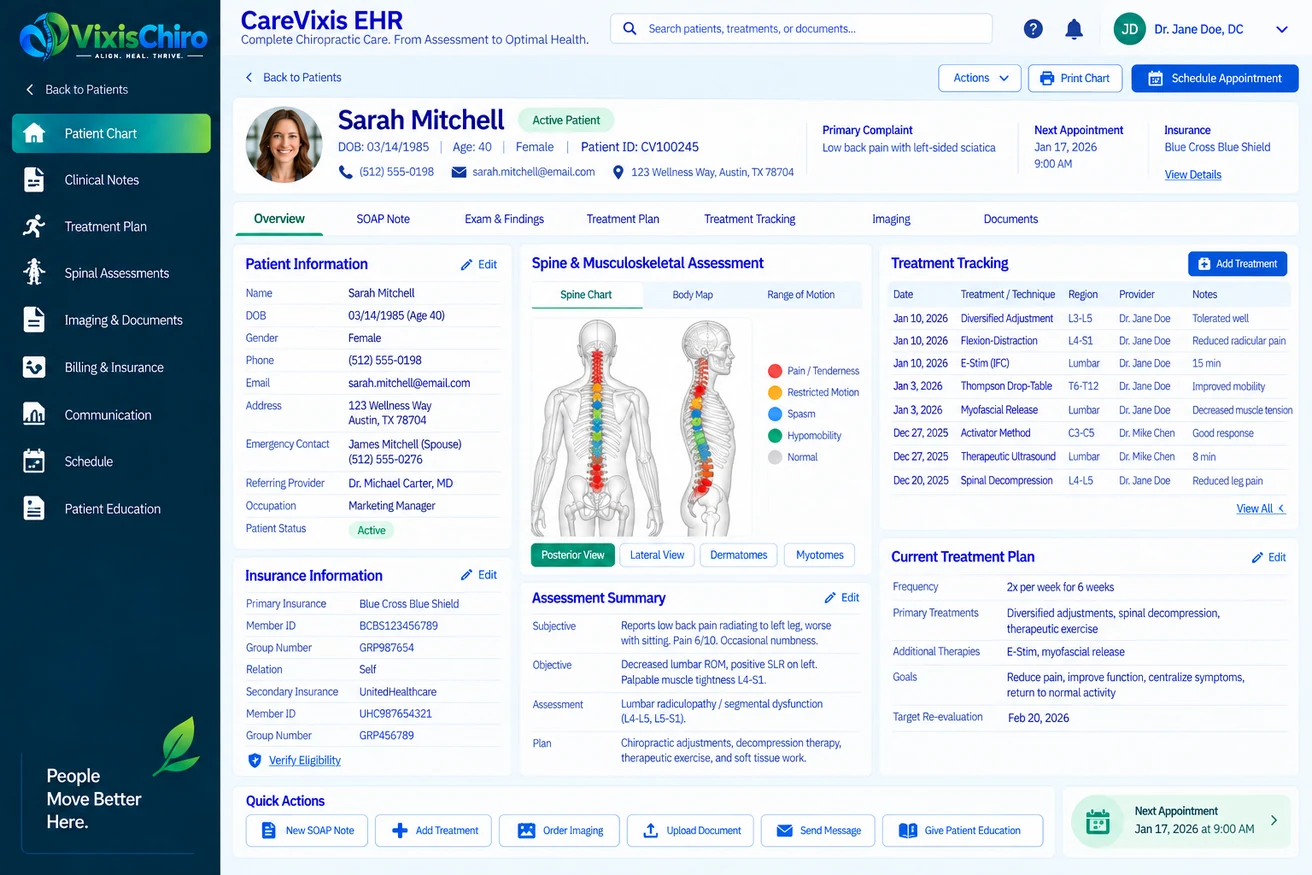
Built Around Chiropractic Workflows
VixisChiro™ supports chiropractic-specific clinical workflows while CareVixis connects revenue management, credentialing, communications, growth and revenue intelligence around the practice. Practices can also keep the software they already use.