Home/VixisIQ™

Revenue Intelligence
Getting Paid Doesn't Mean You Were Paid Correctly.
Your ledger shows what was posted. It cannot tell you whether a payer paid what your contract says, whether an adjustment started last quarter, or which payer is quietly costing you the most. VixisIQ™ reads the revenue data your practice already produces, and tells you.
Start with the free CareVixis practice assessment. No email required.
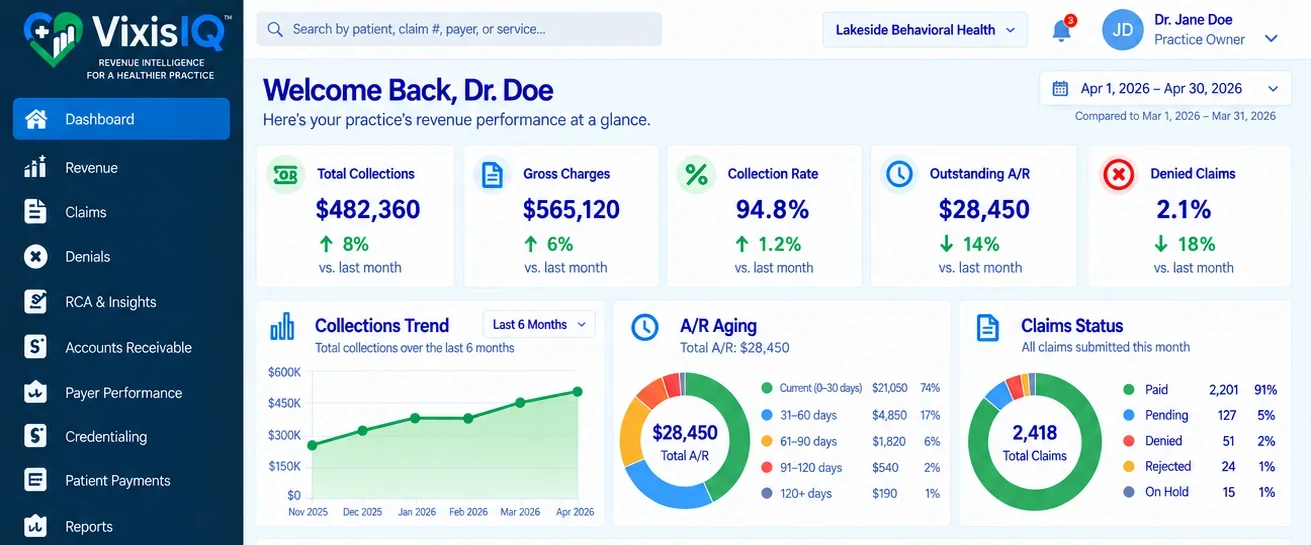
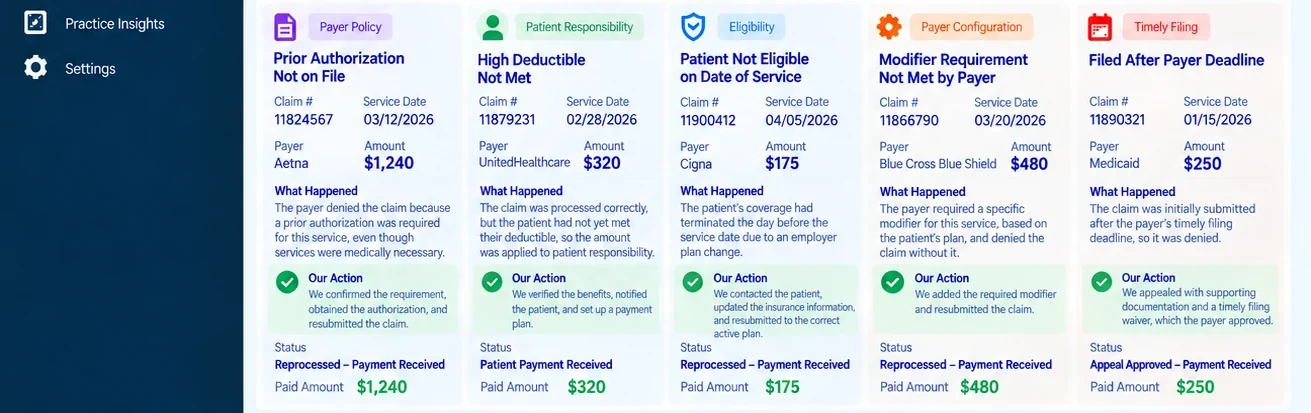
Swipe the screen to see the whole dashboard.
What is VixisIQ™?
VixisIQ™ is the CareVixis revenue intelligence technology. It analyzes healthcare revenue-cycle and remittance data to surface payment patterns, adjustments, denial and rejection patterns, payer behavior, accounts receivable trends and potential revenue opportunities.
VixisIQ™ is not an EHR, an EMR, a practice management system or a clearinghouse, and it does not replace one. It is an intelligence layer that reads what those systems produce. Where appropriate data can be obtained and normalized, VixisIQ™ can analyze the resulting revenue-cycle and remittance information.
The Data Exists. It Is Just Scattered.
A practice generates a large amount of revenue-cycle information, and almost none of it sits in one place. Answering a single question can mean opening four systems.
Your EHR or PM system
Charges, encounters, posted payments and patient balances, organized around the clinical visit rather than around the money.
Your clearinghouse
Submission and rejection detail, claim status responses and the remittance files that come back from each payer.
Payer portals
One login per payer, each with its own layout, its own history window and its own way of describing the same problem.
Spreadsheets
The working memory of the billing process: follow-up lists, appeal trackers and notes that exist nowhere else.
Your biller's workflow
What was worked, what was resubmitted and what was written off, often visible only as a monthly summary.
No single answer
Each system is right about its own piece. Nothing is responsible for the whole path from the claim to the payment.
This is the gap VixisIQ™ is built for. Not another place to enter data, and not a replacement for the systems that already work: a layer that reads the revenue-cycle data those systems produce and reports what it finds.
The Answers Are Already in Your Data
Revenue-cycle data arrives in standard formats. Those standards are what make analysis across payers possible, because the same code means the same thing whichever payer sent it.
| Data | What it carries | What VixisIQ™ can surface from it |
|---|---|---|
Remittance adviceX12 835 |
What the payer paid, adjusted, denied or assigned to the patient, with the reason codes for each decision. | Adjustment and denial patterns, payer by payer. Underpayment indicators. How a given service line is actually being paid. |
Claims and encountersX12 837 |
What was billed, for whom, by which provider, with which codes and modifiers. | Which claim types and which providers repeatedly run into trouble, and where in the process it starts. |
Claim statusX12 276/277 |
Where a submitted claim stands with the payer. | Claims that have stopped moving, and how long each payer actually takes before anything happens. |
Eligibility and benefitsX12 270/271 |
Whether coverage was active and what the benefit looked like. | Whether coverage problems are being caught before the visit or after the denial. |
| Accounts receivable | What is outstanding, how old it is and who owes it. | Aging that is getting worse, balances approaching a filing limit, and whose A/R it really is. |
What CareVixis can analyze for a particular practice depends on the data that practice is able to make available. That scope is confirmed in writing before any commitment, never assumed.
What You Would Be Able to See
These are the categories VixisIQ™ reports on. What any one practice sees depends on its own data, its payers and its own numbers.
Collections
What actually arrived, over time, against what was billed.
Payments
Payment detail by payer, provider and service line.
Adjustments
Where write-offs and reductions are happening, and under which reason codes.
Denials
Denial patterns by payer, reason and claim type rather than one claim at a time.
Rejections
Claims stopped before adjudication, grouped by what stopped them.
Payer performance
How each payer behaves: what it pays, what it questions and how long it takes.
A/R trends
Aging direction, not only today's snapshot.
Revenue opportunities
Balances and patterns that warrant investigation, flagged as questions rather than conclusions.
Claim trends
What is changing over time, including problems that are new this quarter.
Revenue leakage indicators
Places revenue appears to be leaving the process without a decision being made.
Root cause findings
What VixisTrace™ determined about individual problem claims, gathered in one place.
Action items
What CareVixis intends to do next, and who owns it.
What this section does not claim
CareVixis publishes no recovery rate, no denial reduction figure and no revenue increase figure for VixisIQ™. Any number a practice sees in VixisIQ™ is that practice's own data, and every number in the illustration above is sample data, as its caption says.
Where This Fits Without Changing Anything
A conceptual example of the path a claim takes and where VixisIQ™ reads it. This is an illustration of the general flow, not a description of any one practice's configuration.
- Your EHR or practice management systemThe visit is documented and the charge is created. Keep the system you already use.
- Claims and revenue-cycle workflowThe claim is prepared and submitted.
- Clearinghouse and payerThe claim is transmitted, translated where needed, and adjudicated by the payer.
- Remittance information comes backPayments, adjustments, denials and reason codes return to the practice.
- VixisIQ™ reads itRevenue-cycle and remittance data is analyzed for patterns across payers, providers and time.
- VixisTrace™ investigates individual claimsWhen a specific claim needs a root cause, not just a correction.
- Revenue intelligence, and actionWhat was found, what it appears to mean, what CareVixis is doing about it and who owns the next step.
VixisIQ™ is included with CareVixis revenue cycle management at no additional monthly charge. It is part of what the core percentage covers, not a separate subscription. See what CareVixis costs.
Nothing above requires a practice to change its EHR, its practice management system or its clearinghouse. See how CareVixis works alongside existing systems.
VixisTrace™ Finds the Cause. VixisIQ™ Reveals the Pattern.
The two do different jobs and they are strongest together. VixisTrace™ is the CareVixis claim root cause analysis technology: it investigates why an individual claim was rejected, denied, underpaid or otherwise failed to produce the expected result. VixisIQ™ gathers those findings alongside the rest of the revenue-cycle data and shows whether the same cause is happening repeatedly.
One claim tells you something went wrong. Two hundred claims tell you where the process is breaking.
Fix the claim. Then fix what caused it.
Questions Practices Ask About Revenue Intelligence
These answers are on the page, in plain HTML, because they are the reason the page exists.
What is healthcare revenue intelligence?
Healthcare revenue intelligence is the analysis of a practice's revenue-cycle data, including claims, payments, adjustments, denials and remittance information, to identify patterns and problems that individual transactions do not reveal on their own. It answers what happened to the revenue, not only whether a claim was submitted.
Does VixisIQ™ replace my EHR?
No. VixisIQ™ is not an EHR, an EMR or a practice management system, and CareVixis does not require a practice to replace one to use it. VixisIQ™ analyzes revenue-cycle data produced by the systems a practice already runs.
Does VixisIQ™ replace my clearinghouse?
No. A clearinghouse moves and translates transaction data between a practice and its payers. VixisIQ™ analyzes the information that comes back, such as the electronic remittance advice. The two do different jobs and VixisIQ™ does not perform clearinghouse functions.
What is an ERA?
An electronic remittance advice is the electronic statement a payer returns after processing a claim. It reports what was paid, what was adjusted, what was denied and what was assigned to the patient. CMS lists the standard for payment and remittance advice as X12 835.[1]
What is the difference between an ERA and an EOB?
Both explain how a claim was processed. An explanation of benefits is the statement a payer produces explaining coverage, payment and patient responsibility. An electronic remittance advice is the standardized electronic transaction sent to the provider, which is why it can be analyzed at scale.
What are CARCs and RARCs?
They are the code sets that explain a payer's decision. X12 states that claim adjustment reason codes "describe why a claim or service line was paid differently than it was billed".[2] Remittance advice remark codes "are used to provide additional explanation for an adjustment already described by a Claim Adjustment Reason Code (CARC) or to convey information about remittance processing".[3] Read together across many claims, they are the vocabulary of a denial pattern.
What data does VixisIQ™ need?
VixisIQ™ works from revenue-cycle data such as remittance advice, claim and payment detail and accounts receivable information. What CareVixis can analyze for a given practice depends on the data that practice can make available, so the scope is confirmed before any commitment.
Is VixisIQ™ an artificial intelligence product?
No. VixisIQ™ is a proprietary analysis engine that CareVixis builds and owns. Its findings are reviewed by the CareVixis team, who remain accountable for what a practice is told about its revenue.
Do I have to leave my current biller to see this?
That is a conversation, not a requirement. CareVixis is a revenue management company and normally takes responsibility for the work it reports on, because visibility without accountability tends to produce a nicer report and the same result. What that looks like for a specific practice is agreed up front.
See What Your Revenue Data Is Telling You
Keep your EHR. Keep your clearinghouse. Let CareVixis show you what is happening between the claim and the payment.
Free. No obligation. No email required.
Sources
- Centers for Medicare & Medicaid Services, Transactions (HIPAA Administrative Simplification). Lists the adopted standards, including Payment and Remittance Advice (X12 835), Claims and Encounter Information (X12 837), Claim Status (X12 276/277), Eligibility and Benefits (X12 270/271) and Referrals and Authorizations (X12 278). cms.gov. Accessed 18 September 2026.
- X12, Claim Adjustment Reason Codes. "These codes describe why a claim or service line was paid differently than it was billed." The two character group code assigns responsibility for the adjustment: CO contractual obligation, CR corrections and reversal, OA other adjustment, PI payer initiated reduction, PR patient responsibility. x12.org. Accessed 18 September 2026.
- X12, Remittance Advice Remark Codes. "Remittance Advice Remark Codes (RARCs) are used to provide additional explanation for an adjustment already described by a Claim Adjustment Reason Code (CARC) or to convey information about remittance processing." Supplemental RARCs explain an adjustment; informational RARCs, called Alerts, "convey information about remittance processing and are never related to a specific adjustment or CARC." x12.org. Accessed 18 September 2026.
These sources describe the standards and code sets the industry uses. They are not CareVixis results and they make no claim about CareVixis performance.
Visibility Is Different From Resolution
VixisIQ™ surfaces revenue patterns, payer behavior, A/R and denial intelligence. When a claim problem needs investigation and root-cause resolution, VixisTrace™ carries that work forward.