Home/VixisTrace™/For chiropractic practices
For chiropractic practices
Do You Know Which of Your Adjustments Actually Got Paid?
VixisTrace™ shows you. Free.
Your payers already told you what they paid, what they denied and the reason they gave. Upload that remittance data and see it in one place, claim by claim, whichever chiropractic software you bill out of.
Free for chiropractic practices • No credit card required
- Encrypted DataEncrypted in transit and at rest. Nobody can read it except the people you give access to.
- Multi-Factor AuthenticationProtects your account and billing data.
- Business Associate AgreementWe provide a BAA for HIPAA compliance, before you upload PHI.

Security and compliance standards
- HIPAA Compliant
- HITECH Compliant
- SOC 2 Compliant
- PCI DSS Compliant
- NIST Aligned
In Chiropractic, Five Things Decide Whether the Visit Gets Paid.
None of them are about how well you adjusted the patient. All five show up later, in what the payer sends back.
-
The rules belong to the plan, not to the insurance company.
Covered services, network status and what the patient owes are set by the specific plan in front of you. HealthCare.gov states that the services covered in each broad benefit category can vary, and its own instruction for finding out whether a particular service is covered is to call the plan. Verifying the carrier is not the same as verifying the plan, and your front desk is the one that finds out.
Source: HealthCare.gov, what Marketplace plans cover.
-
Medical necessity has to be visible in the record.
For Medicare, the patient must have a subluxation of the spine demonstrated by x-ray or physical exam. When further clinical improvement cannot reasonably be expected from continued care and the treatment becomes supportive rather than corrective, it is maintenance therapy. That is a judgement about the record, so a course of care that was covered in week one can stop being covered later without anything about your technique changing.
Source: CMS Chiropractic Services Medical Policy Article (A57889).
-
Medicare covers less of the visit than the visit contains.
Coverage extends only to manual manipulation of the spine to correct a subluxation. Medicare does not cover chiropractic treatment of extraspinal regions, and it does not pay for other services or tests a chiropractor orders, including X-rays, massage therapy and acupuncture. A chiropractor's x-ray can still be used for claims processing purposes, but payment for it is not available. Work you genuinely performed can sit outside coverage entirely.
Sources: CMS A57889; Medicare.gov, chiropractic services.
-
Two characters carry the whole claim.
A chiropractor must place the AT modifier on a claim when providing active or corrective treatment for acute or chronic subluxation. Maintenance therapy does not qualify for it. So a missing modifier, a diagnosis that does not line up, or notes that do not support the visit turns a treated patient into a correction, a records request or an appeal, and that work lands on whoever in your office has time.
Source: CMS Chiropractic Services Medical Policy Article (A57889).
-
The patient estimate is a guess until benefits are checked.
What a patient pays is decided by the deductible, the copayment or coinsurance, and the out-of-pocket maximum, and excluded services fall to them in full. In a specialty built on frequent low dollar visits, that conversation happens at the front desk over and over, and getting it wrong costs you the collection and the goodwill at the same time.
Source: HealthCare.gov, your total costs for health care.
Your Remittance Data Already Says Which Ones Failed.
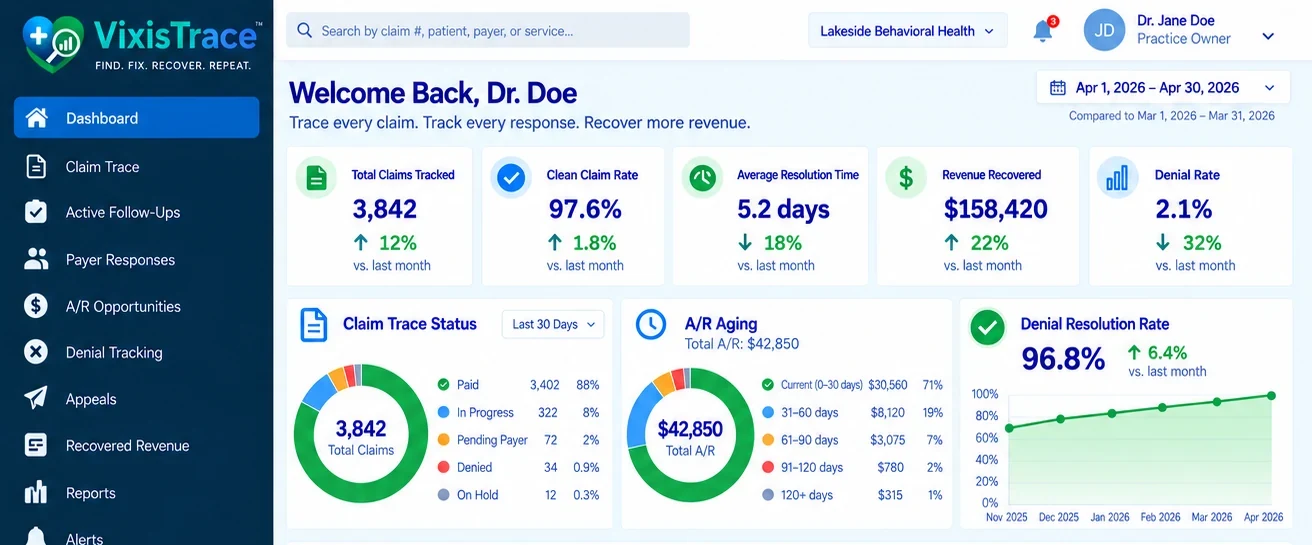
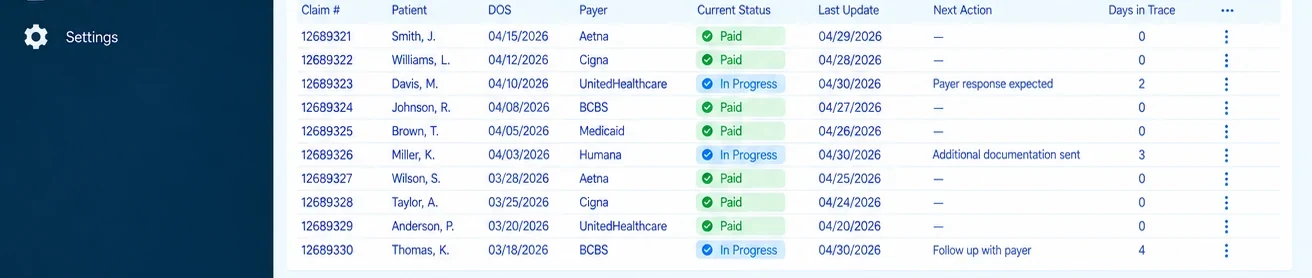
VixisTrace™ reads the billing and remittance data your practice already receives and turns it into a plain picture of your billing health.
- PaymentsSee what was paid and when.
- Outstanding ClaimsKnow which visits are still unpaid.
- DenialsIdentify denied claims and the reason given.
- AdjustmentsSee all adjustments at a glance.
- Problem ClaimsFind claims that need attention.
- Root CausesUnderstand why the same denial repeats.
- A/R HealthSee your A/R by age bucket.
Two of Those Five Happen Before the Visit. Be Clear About Which.
VixisTrace™ reads what came back. It shows you the denial, the reason code, the claim that is stuck and the pattern underneath it, which is the honest answer to reasons three, four and five once the claim has been adjudicated.
Checking a specific plan before the patient is on the table, and documenting the reason for treatment so the record carries the medical necessity, are not things an analysis of remittance data can do for you. They are people work, and they are the work CareVixis does as a service around whatever software you already run. Nothing here asks you to change your chiropractic system, and the data import is a supported data import, not a native integration.
VixisTrace™ finds the cause. VixisIQ™ reveals the pattern.
CareVixis publishes no denial rate, no recovery rate and no revenue figure for chiropractic practices. The objective is continuous improvement: identify preventable patterns, address their causes, and reduce unnecessary repeat failures.
Sources
- Centers for Medicare & Medicaid Services, Chiropractic Services Medical Policy Article (A57889), Medicare Coverage Database. Source of the statement that coverage extends only to treatment by means of manual manipulation of the spine to correct a subluxation, that the patient must have a subluxation demonstrated by x-ray or physical exam, that no other diagnostic or therapeutic service furnished by a chiropractor or under the chiropractor's order is covered, that Medicare does not cover chiropractic treatments to extraspinal regions, that a chiropractor must place an AT modifier on a claim when providing active or corrective treatment, and that care which becomes supportive rather than corrective is maintenance therapy. cms.gov. Accessed 27 September 2026.
- Medicare.gov, Chiropractic services. Source of the statement that Part B only covers adjustments of the spine by a chiropractor to correct a subluxation, and that Medicare does not cover other services or tests a chiropractor orders, including X-rays, massage therapy and acupuncture. medicare.gov. Accessed 27 September 2026.
- HealthCare.gov, What Marketplace health insurance plans cover. Source of the statement that the specific services covered in each broad benefit category can vary, and of the instruction to call the plan to find out whether a particular service is covered. healthcare.gov. Accessed 27 September 2026.
- HealthCare.gov, Your total costs for health care. Source of the deductible, copayments and coinsurance, and the out-of-pocket maximum as the components that decide what a patient pays. healthcare.gov. Accessed 27 September 2026.
Medicare coverage articles are contractor specific and are revised. The rules that apply to your practice are those of your own Medicare Administrative Contractor on the date of service, and commercial plans set their own terms, which is one of the things a review should establish rather than assume. Nothing on this page is legal, coding or billing advice for a specific claim.
Start With What You Already Have.
You do not need a new chiropractic system to find out where your revenue is stuck. You need someone to read the data your payers are already sending you.
Free for chiropractic practices • No credit card required
CareVixis works from the billing and remittance data your practice already receives, whichever chiropractic software you use. No API integration, native integration, certification or partnership with any chiropractic software vendor is claimed. Product names and brands are the property of their respective owners.